
Article · Brownfield · Series Intralogistics Trends 2027 · Part 3
Retrofit during ongoing operations
Space for new buildings is scarce, investments are scrutinised more closely – and many systems have been running for decades. When modernising an existing system pays off, how a conversion can be carried out in phases without prolonged downtime, and what two case studies show.
Context
Modernising without
stopping shipments.
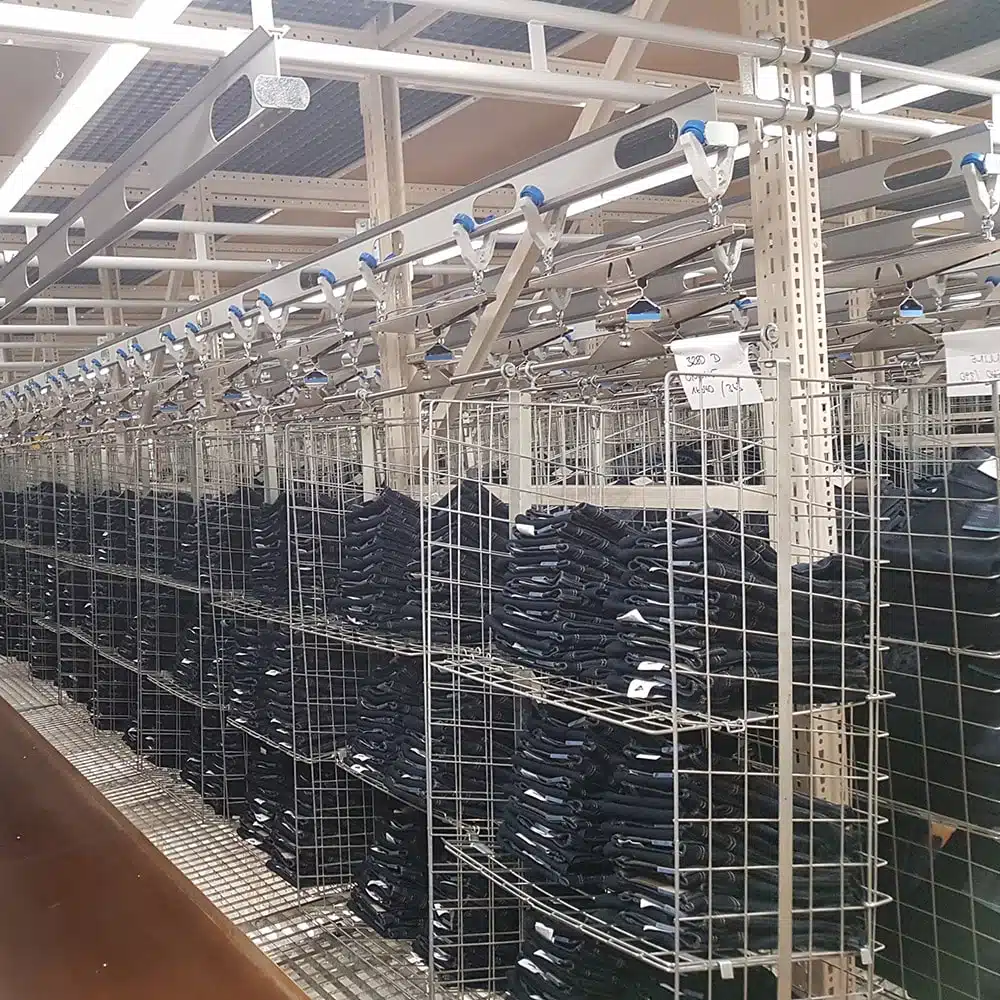
Many overhead conveyor systems in warehouses and distribution centres have been running for 20 years or more. Mechanically, they are often in good condition – the bottlenecks are the control system, electronics and spare parts. Some manufacturers of older systems are no longer on the market, and electronic components are no longer available. If the system fails during peak season, the result is delayed deliveries and dissatisfied customers.
At the same time, requirements are changing: more e-commerce, more returns, smaller batch sizes. A new building is not always necessary to meet them. A retrofit – that is, the modernisation and extension of the existing intralogistics – can continue to use the building, existing structures and parts of the technology.
The key question is usually not whether, but how: how can a system be converted while goods are being received, stored and shipped? This article sets out the criteria, the typical process and two projects by Schoenenberger Systems.
- Three types of retrofit: renewing the control system and electrics, extending the system or reorganising processes within the existing building.
- Phases instead of downtime: section-by-section installation; the old technology keeps running until a single, consolidated switchover.
- Check the building: existing structures can often continue to be used.
- Observe the rules: conversions can constitute a substantial modification under the Machinery Regulation.
What retrofit covers
Three types of retrofit –
from the control cabinet to a new logistics centre.
Renewing controls, electrics and safety
The mechanics remain; the control system (PLC), electrical components, visualisation and safety equipment are renewed. This can also apply to systems not supplied by Schoenenberger Systems. Example: MEWA, see below.
Adding to an existing system
New tracks, buffers or functional areas are connected to the existing system – in the case of third-party systems, if necessary by transferring the goods onto OMNIFLO trolleys. Conventional long-trolley systems can also be supplemented with a single-carrier system for e-commerce.
Restructuring processes in the existing building
The building remains, while conveyor technology and processes are fundamentally redesigned – for example, from a pure hanging garment warehouse to a multifunctional central warehouse. Example: Bugatti, see below.
Decision
New build or retrofit?
Five criteria for the decision.
- Building and structureCan the ceilings and existing steel structures carry additional loads? Are the room height and floor plan sufficient for future processes?
- Condition of the technologyAre the mechanics still sound, and where do the actual bottlenecks lie – control system, electronics, spare parts, performance?
- Future requirementsWhich channels, product ranges and volumes should the system be able to handle in five to ten years?
- Operating hoursWhen is a conversion possible without jeopardising seasonal peaks? How long may the final switchover take?
- Overall assessmentInvestment, implementation time, training and resource consumption compared – not just the purchase price.
- Often lower costs than dismantling and building new
- Less planning and implementation effort
- Training employees is usually easier
- Implementation possible during ongoing operations
- Reusing existing hardware saves resources and CO₂
Process
In six phases from the
existing system to the new one.
A retrofit during ongoing operations stands or falls with its planning. The basic idea: the existing system keeps working until the new one is ready – section by section, level by level or functional area by functional area. The switchover is concentrated into a short, planned time window.
How long a project takes depends on its scope, the building and operating hours. At Bugatti, around seven months passed between the start of installation and completion; the actual switchover took one week.
A guide, not a rule: only an on-site assessment shows which option is more economical.
Typical project process
-
1On-site assessmentMechanics, control system, electrics, spare parts situation, building and processes are recorded on site.
-
2Requirements specification & target conceptWhat should the system deliver in future – and what remains, what is renewed?
-
3Simulation & phased planDefine the sequence of construction phases so that goods-in, storage and shipping continue to run.
-
4Section-by-section installationOne area is cleared and converted while the others continue to work as normal.
-
5Consolidated switchoverThe last old components are replaced within a short, planned time window.
-
6Training & ramp-upEmployees are instructed and the system is optimised in operation – followed by service and maintenance.
Case study 1 · Reorganise
Bugatti Retail, Goslar: new-build plans
dropped, existing site rethought.
In 2017, bugatti Retail GmbH wanted to expand its hanging garment warehouse in Goslar into a multifunctional central warehouse – for its own full range and four other brands of the group, for stores, outlets and e-commerce. Depending on batch size, returns were to be processed and ready for dispatch again within one day.
The existing transport and storage system was not flexible enough for this; a new building was planned. Schoenenberger Systems assessed the existing building structure as sufficient and proposed implementing the reorganisation with OMNIFLO entirely within the existing building – including the use of the existing steel structure.
In October 2017, the conversion began on the top floor. While work continued as normal on the floors below, the installation team cleared one level after another and installed the new system. This was followed by the level with the ironing area, returns workstations and tunnel finisher, and finally goods-in and goods-out, quality control and the packing area. The old conveyors kept running until the end and were replaced in one final week. The conversion was completed in May 2018.
The proposal from Schoenenberger Systems was so convincing that we dropped our new-build plans immediately. The modular Omniflo system could be fitted completely into the existing environment and designed according to our ideas.

- Conversion from October 2017 to May 2018 during ongoing operations
- Four storage levels, each roughly the size of a football pitch
- Around 8,000 metres of rail track, 8 floor-to-floor conveyors
- Schoenenberger Systems as general contractor, including ergonomic workstations
- Mobile workstations on all storage levels
Case study 2 · Modernise
MEWA, Manching: a 25-year-old
system made fit for the future.
The textile service provider MEWA supplies workwear and cleaning cloths as a rental service – a business in which large volumes of garments pass through laundry, inspection and order picking every day. At the Manching site, overhead conveyor technology from Schoenenberger Systems had been in use for more than 25 years.
Instead of replacing the system, it was modernised: the software was updated, and individual system components and devices were replaced. This allowed MEWA to fundamentally renew its intralogistics while continuing to use the existing mechanics – an example of the first type of retrofit.
You can read more about the sustainability aspect of the project in our article Sustainability through retrofit and intelligent intralogistics (in German) and in the trade article Focus on sustainability and efficiency (in German) (Technische Logistik, 09/2024).

What matters
Six pitfalls –
and how to avoid them.
Spare parts and electronics
For older systems, control and electronic components are often no longer available. Clarify early on which components are critical – before a failure during peak season forces the decision.
Interfaces between old and new
Trolleys, rail profiles and transfer points must fit together. With third-party systems, transferring the goods onto new trolleys can make sense.
Building and structural engineering
Check load-bearing capacity, fire protection and escape routes. Existing steel structures can be an opportunity – as at Bugatti – but must be assessed.
Controls and data
New control system, old IT: the connection to WMS and ERP belongs in the requirements specification, as do visualisation and remote maintenance.
Timing
Plan construction phases and the final switchover outside seasonal peaks – and build in a buffer for the unexpected.
People
Involve and train employees early. At Bugatti, change requests were implemented directly during installation – which builds acceptance.
Regulation
Retrofit and the Machinery Regulation:
when a conversion becomes a manufacturer issue.
The EU Machinery Regulation (EU) 2023/1230 applies from 20 January 2027. Existing systems enjoy grandfathering protection – but a conversion can be a substantial modification if it creates new hazards or increases risks and requires additional protective measures. In that case, whoever carries out the conversion assumes the obligations of a manufacturer.
Especially when retrofitting the control system and safety equipment, it is worth clarifying this question at the outset – and determining who takes responsibility for the modified system.
To the article on the Machinery RegulationThe Schoenenberger Systems approach
Retrofit from a single source –
from on-site assessment to service.
Retrofit has been part of Schoenenberger Systems' core business for decades. The starting point is a comprehensive on-site assessment, from which an individual requirements specification is developed. The aim is always an economical investment – not the largest possible conversion.
Modernisation covers not only mechanical components but also the control system (PLC), electrical installation, visualisation and safety equipment – including for systems from other manufacturers, provided the systems are compatible. For extensions, the modular OMNIFLO system is available, which can be adapted to existing structures.
- On-site assessment and requirements specification
- Renewal of control system, electrics and visualisation
- Upgrading of safety equipment
- Extension, including of third-party systems
- Planning, simulation and installation during ongoing operations
- Training, service and maintenance


Checklist
Seven questions before
your retrofit project.
- Identify the bottleneckWhat is holding you back today: breakdowns, spare parts, performance, missing functions or new channels?
- Check the spare parts situationWhich control and electronic components are critical or no longer available?
- Assess the buildingCan the ceilings and steel structures carry the planned technology? Are room height and floor space sufficient?
- Define the target conceptWhich processes, volumes and channels should the system cover in the coming years?
- Plan time windowsWhen are construction phases and the final switchover possible outside seasonal peaks?
- Clarify responsibilityIs there a substantial modification, and who assumes the manufacturer's obligations?
- Involve the teamWho from logistics, IT and maintenance will support the project and be trained?
FAQ
Frequently asked questions about
retrofit in intralogistics.
What does retrofit mean in intralogistics?
Is a conversion possible during ongoing operations?
When does a retrofit pay off compared with a new build?
Can systems from other manufacturers also be modernised?
What does retrofit have to do with the Machinery Regulation?
How long does a retrofit project take?
Sources: Schoenenberger Systems, success story bugatti Retail GmbH, Goslar · Technische Logistik, „Nachhaltigkeit und Effizienz im Fokus" (Retrofit & Maintenance, 09/2024) · materialfluss, article on retrofit and intelligent intralogistics (11/2025) · Schoenenberger Systems, services page on the retrofit of overhead conveyor systems · Regulation (EU) 2023/1230 (Machinery Regulation). Status: November 2026.
Series Intralogistics Trends 2027
Read on.
All trends in a compact overview.
To the overviewNew obligations, retrofit and AI in machinery.
Read articleMaking returned items available again more quickly.
Read articleWhen a retrofit pays off and how the conversion succeeds.
Which data AI agents need from conveyor technology.
Coming soonOn-site assessment · Requirements specification · Implementation
Modernise your system
without stopping operations?
We take a look at your existing system on site and show you what can stay, what should be renewed and how the conversion can be planned in phases – including for systems from other manufacturers.