
Series · Intralogistics · AI & automation
Intralogistics Trends 2027
AI is starting to act, robots are moving into the warehouse, new EU rules are taking effect. Eight developments that are likely to shape warehouses and distribution centres in 2027 – and where overhead conveyor technology can contribute.
Context
When AI does not just plan
but acts.
2027 marks a turning point: in supply chains, artificial intelligence is starting not only to analyse, but to plan, decide and act independently. The DHL Logistics Trend Radar 8.0 (September 2026) lists agentic AI and humanoid robots as trends in their own right for the first time. At the same time, new EU rules are changing the framework: the EU Machinery Regulation applies from 20 January 2027, and since July 2026 large companies have no longer been permitted to destroy unsold textiles.
For operators of warehouses and distribution centres, the question is therefore less whether AI is coming – and more whether the physical material flow is ready for it. After all, every decision made by software ultimately has to be executed mechanically: reliably, traceably and at single-item level.
Schoenenberger Systems has been developing overhead conveyor technology since 1977 – 50 years in 2027. This overview puts into context the eight developments that we consider most relevant. We examine four of them in more detail in dedicated articles.
- AI becomes operational: agentic AI plans and controls – but needs clean real-time data from the material flow.
- Physical AI needs floor space: conveyor technology below the ceiling can keep floor areas free for people and robotics.
- Regulation becomes a planning factor: Machinery Regulation (January 2027), AI Act (high-risk rules from December 2027), ban on the destruction of unsold textiles.
- Retrofit remains cost-effective: modernisation during ongoing operations instead of a new build.
Overview
The 8 most important intralogistics trends for 2027.
- 1Agentic AI: from assistant to acting system
- 2Physical AI & humanoid robots
- 3Digital twins & simulation
- 4Machinery Regulation & AI Act
- 5Returns & circular fashion
- 6Retrofit instead of new build
- 7Vertical use of space
- 8Augmented workplace: people & machines
Agentic AI: from assistant to acting system
In 2027, agentic AI systems will take on operational tasks: they prioritise orders, allocate resources and route material flows around bottlenecks. The DHL Logistics Trend Radar 8.0 counts agentic AI among the new trends with the greatest impact. Gartner, however, expects more than 40 % of agentic AI projects to be discontinued by the end of 2027 – often because the data foundation is missing.
The Schoenenberger Systems approach: in the ILS 2100, every item is identified by barcode or RFID. The conveyor technology thus supplies item-level data and reliably executes decisions from the WMS, ERP or AI.

Physical AI & humanoid robots: the warehouse floor becomes a workspace
With physical AI, artificial intelligence moves into the physical world: systems perceive their surroundings, move collaboratively and pick items. Humanoid robots appear on the DHL Trend Radar 8.0 for the first time – as a long-term trend. For warehouse planning, this means that mobile robots and people share the floor space, and every free square metre creates room for manoeuvre.
The Schoenenberger Systems approach: overhead conveyor technology uses the space below the ceiling for transport, buffering and sorting. The floor remains largely free; transfer points to packing or robot stations can be planned on a project-specific basis.

Digital twins: simulate first, then invest
High construction costs and fluctuating order volumes make bad investments expensive. Layouts, throughput and buffer strategies are therefore increasingly tested virtually before anything is built – although the results are only meaningful if the conveyor parameters in the model are correct.
The Schoenenberger Systems approach: simulation is an integral part of project engineering – alongside consulting, planning and customer-specific load carriers. Material flows and performance limits are assessed together with the customer.

Machinery Regulation & AI Act: compliance becomes a planning factor
On 20 January 2027, the EU Machinery Regulation (EU) 2023/1230 replaces the Machinery Directive – with new requirements for cybersecurity, software and self-learning systems. In parallel, the Digital Omnibus on AI has redefined how AI in machinery is classified. For new-build, expansion and retrofit projects, compliance therefore becomes a planning factor.
The Schoenenberger Systems approach: certified quality management in accordance with DIN EN ISO 9001:2015 and a preventive approach: preventing errors takes priority over detecting them.

Returns & circular fashion: every item counts
Since 19 July 2026, large companies in the EU have no longer been permitted to destroy unsold textiles and footwear; a digital product passport for textiles is in preparation. Returns and overstock must therefore go back on sale faster and traceably – with return rates in fashion e-commerce of 30 to 40 % in some cases.
The Schoenenberger Systems approach: the ILS pouch sorter handles hanging garments and flat-packed goods in one system. After inspection, returned items can go directly to the dispatch buffer – without being put back into storage.

Retrofit instead of new build: modernising during ongoing operations
Land for new buildings is scarce and expensive in Europe. Automation is therefore increasingly taking place in existing buildings. The demand is for modular solutions that can grow in stages and pay off quickly – without replacing the existing system entirely.
The Schoenenberger Systems approach: retrofit has been part of our core business for decades. At Bugatti in Goslar, an existing hanging garment warehouse was converted into a central warehouse for five brands during ongoing operations – instead of a new build.
Vertical use of space: unlocking the third dimension
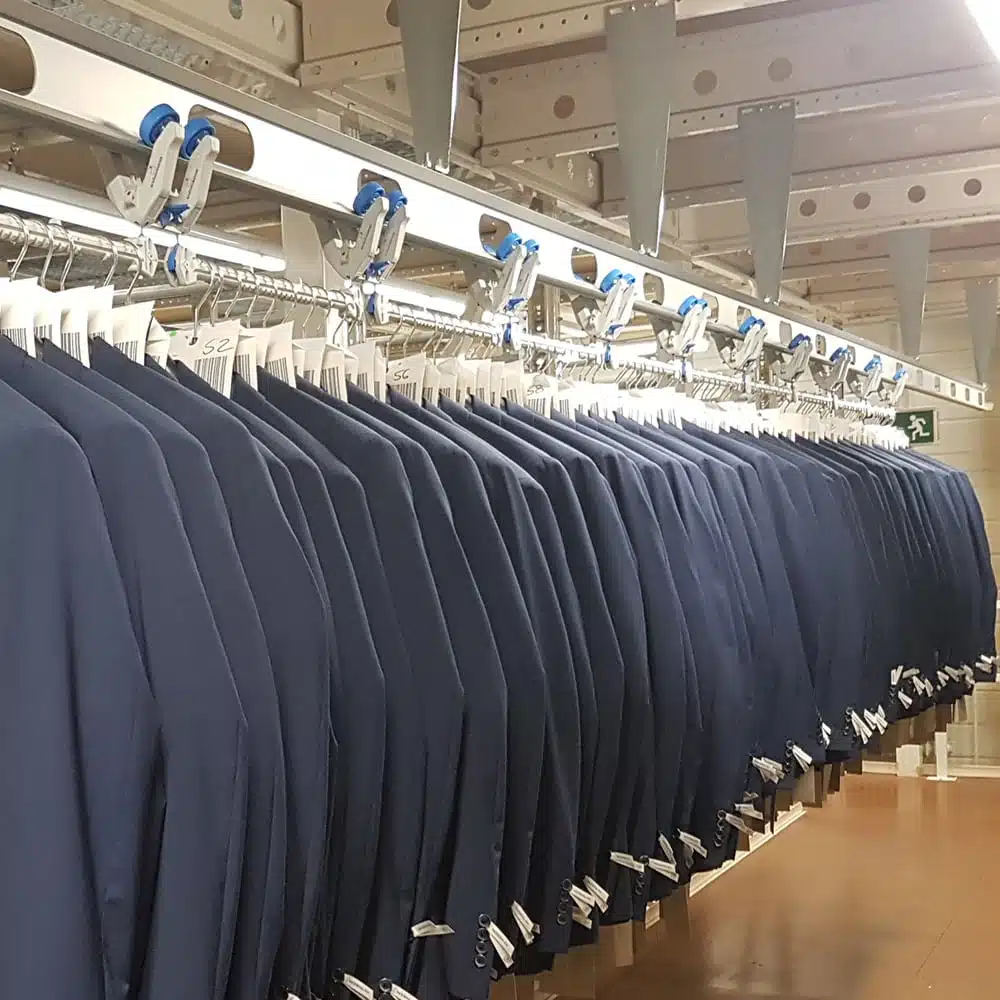
Logistics space and energy remain expensive, while the space below the hall ceiling often goes unused. Following the EU Omnibus, the CSRD obligation now only applies to companies with 1,000 or more employees and €450 million or more in turnover – but large customers can still request efficiency data from their suppliers.
The Schoenenberger Systems approach: “Think along new lines” – and use the space below the ceiling: overhead conveyor technology moves transport and buffering upwards; space savings of up to 50 % are possible.

Augmented workplace: automation relieves people
“The future of logistics does not hinge on the question of humans or AI” – this is how DHL Chief HR Officer Thomas Ogilvie sums up the Trend Radar 8.0. Skilled workers remain scarce; automation is primarily intended to take over physically demanding and monotonous tasks.
The Schoenenberger Systems approach: the LOADING LOOP enables back-friendly unloading of hanging garments from lorries at up to 10,000 items per hour. Staff training is part of every project.

Series
The trends in detail –
four in-depth articles.
We examine four developments more closely in dedicated articles – where overhead conveyor technology can make a particularly significant contribution.
New obligations from 20 January 2027, AI in machinery under the Digital Omnibus on AI, and what counts as a substantial modification in retrofit projects.
Read articleHow fashion companies can make returned items available again faster – and what the digital product passport means.
Read articleWhen modernising existing facilities pays off and how to carry out the conversion in stages – with practical examples from Bugatti and MEWA.
Read articleWhich data AI agents need from the conveyor technology – and how single-item tracking lays the foundation.
Coming soonWhat to do now
First establish a stable material flow –
then build AI on top of it.
The technology is developing quickly, and the regulatory framework is catching up. For decision-makers in warehousing and distribution, this results in a sensible sequence: first put the data foundation and the physical material flow on a reliable footing, then build AI applications on top of them step by step.
Key dates
-
119 July 2026 · Ban on the destruction of unsold textilesLarge companies are no longer permitted to destroy unsold clothing and footwear.
-
220 January 2027 · EU Machinery RegulationMandatory for all machinery newly placed on the market – including requirements for software and cybersecurity.
-
316–18 March 2027 · LogiMAT StuttgartInternational trade fair for intralogistics – experience the trends of the year live.
-
419 March 2027 · CSRD Omnibus national transpositionDeadline for transposing the amended sustainability reporting rules into national law.
-
52 December 2027 · AI Act high-risk obligationsObligations for stand-alone high-risk AI systems take effect – following the postponement under the Digital Omnibus on AI.
Reference projects
Trends in practice:
where Schoenenberger Systems solutions are in operation.
Selected projects from fashion, textile logistics, e-commerce and automotive – from single-item sorting to precisely timed supply to the assembly line.
ILS 2100 · ILS pouch sorter
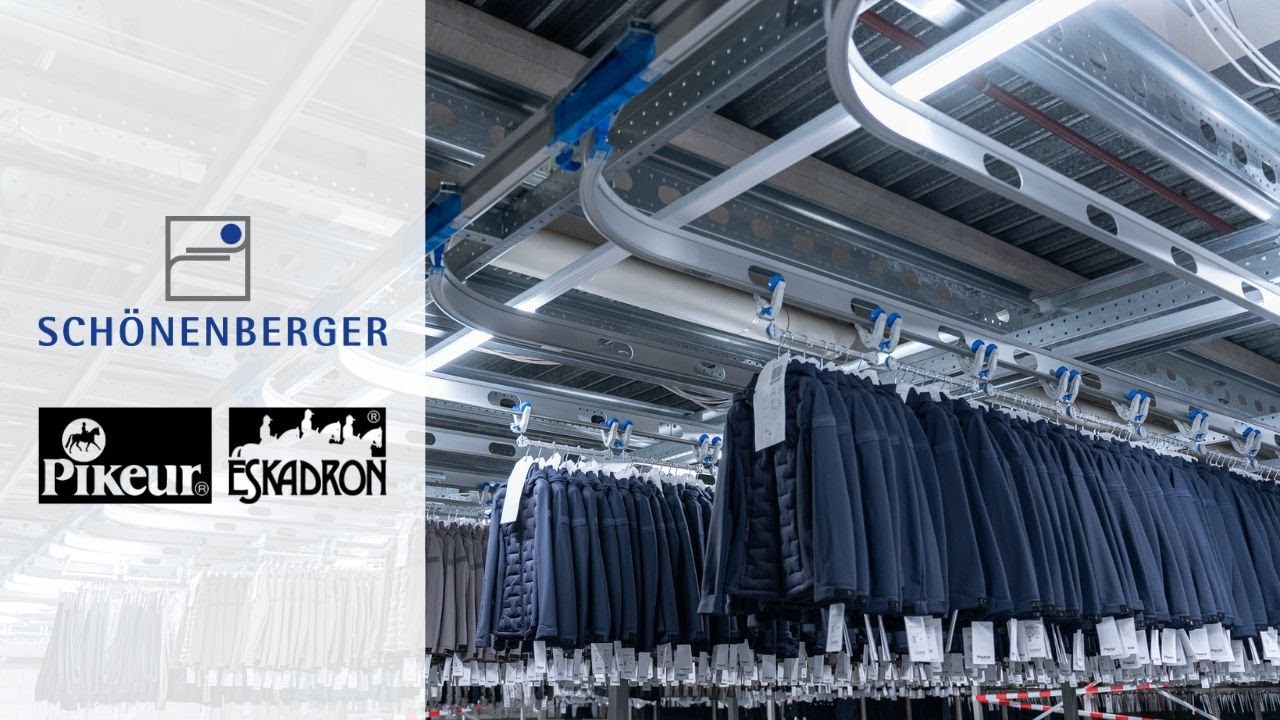
Pikeur and Eskadron combine equestrian fashion and riding equipment in one distribution centre. Hanging garments on hangers, flat-packed goods in sorter pouches – both on the same rails, fully automatically at the same packing station. After inspection, returned items go directly to the dispatch buffer.
More about the ILS pouch sorterOMNIFLO · Retrofit
Bugatti Retail GmbH uses overhead conveyor systems from Schoenenberger Systems to handle its fashion range. OMNIFLO handles multi-level transport in the logistics centre – from goods receipt to dispatch.
Read the Bugatti success storyOMNIFLO · ILS 2100
Digel relies on overhead conveyor technology from Schoenenberger Systems for warehouse and dispatch logistics. Different order sizes from B2B and B2C channels run in one continuous process.
Read the Digel success storyOverhead conveyor technology · just-in-sequence
At Faurecia, seat covers are delivered to the assembly line precisely on time and in the correct sequence – with RFID-based tracking of every single part.
Read the Faurecia success storyIntegrated overhead conveyor solution
The Witt Group connects goods receipt, warehouse and goods issue via a continuous overhead conveyor system – for short response times in both the B2C and B2B channels.
Automated intralogistics
For the French mail-order company Plus, the material flow is fully automated from goods receipt through picking to dispatch.
Reference video
Pikeur & Eskadron –
automated material flow in operation.
FAQ
Frequently asked questions about
intralogistics trends 2027.
What are the most important intralogistics trends for 2027?
What does agentic AI mean in intralogistics?
What changes with the EU Machinery Regulation from 20 January 2027?
What role does overhead conveyor technology play in AI-supported warehouses?
Is retrofit worthwhile compared with a new build?
How does automation help with the ban on the destruction of unsold textiles?
Sources: ¹ Mordor Intelligence, Europe Intralogistics Automation Market (09/2026) · ² Fortune Business Insights, Intralogistics Market Forecast to 2034 · DHL Group, Logistics Trend Radar 8.0 (press release of 24 September 2026) · Gartner, forecast on agentic AI projects (06/2025) · Regulation (EU) 2023/1230 (Machinery Regulation) · EU AI Act / Digital Omnibus on AI (2026) · Directive (EU) 2026/470 (Omnibus I, CSRD) · German Environment Agency (UBA), ban on the destruction of unsold textiles (07/2026) · Dekra labour market report 2026 · LogiMAT Stuttgart, 2027 trade fair dates. All information provided without guarantee; as of autumn 2026.
LogiMAT 2027 · 16–18 March · Stuttgart
Ready to make your intralogistics
fit for 2027?
We analyse your material flow and show which combination of overhead conveyor technology can support your processes – in an existing building or a new build. Get in touch or meet us at LogiMAT 2027 in Stuttgart.